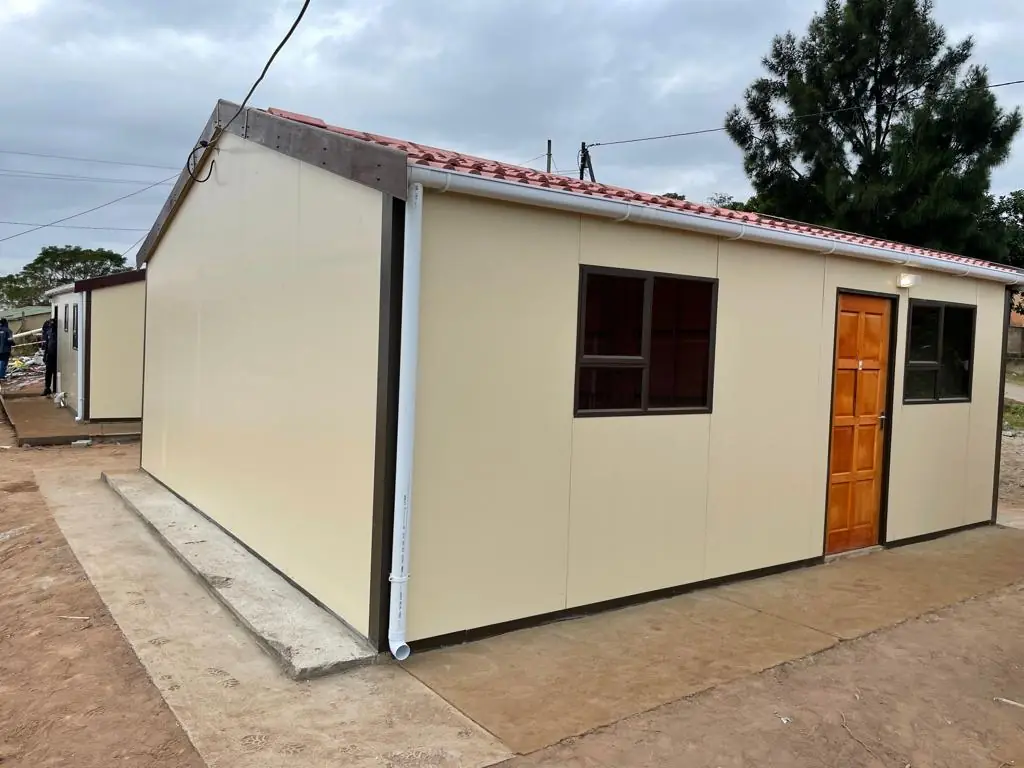
A UDRS modular home is manufactured off-site, delivered flat and assembled on site in days, and it is relocatable by design. The pilot units in Kya Sand are built, placed and lived in. Inside: panel joints finished square, a wired socket, a screeded floor and a bathroom with a toilet and shower. Each unit costs R150 000 and assembles on site in 7 days; floor area is still TBC.
At a glance — as of October 2026
- Status
- Pilot: units in Kya Sand, built, placed and lived in
- How it's built
- Manufactured off-site, delivered flat, assembled on site in days
- Inside
- Square-finished panel joints, a wired socket, a screeded floor, a bathroom with toilet and shower
- Relocatable
- Yes, by design — the unit can be lifted and moved
- Cost per unit
- R150 000
- Assembly on site
- 7 days
- Units & amenities built
- 41, counting libraries and classrooms as well as homes
- Floor area
- TBC — being finalised for the production unit
- Next step
- Costing the repeatable version
What is a UDRS modular home?
It is a home that is made in a workshop, not improvised in a yard. The wall panels are manufactured off-site, stacked flat for delivery, and assembled on the plot. Quality is controlled in the workshop, and site time drops to days.
It is also relocatable on purpose. Tenure in a settlement is rarely permanent, and a home that can't move becomes a home that gets abandoned. A unit that can be lifted and moved means a family isn't forced to choose between a home and a chance at land.
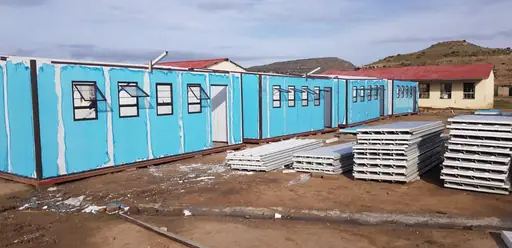
Panels leave the workshop flat
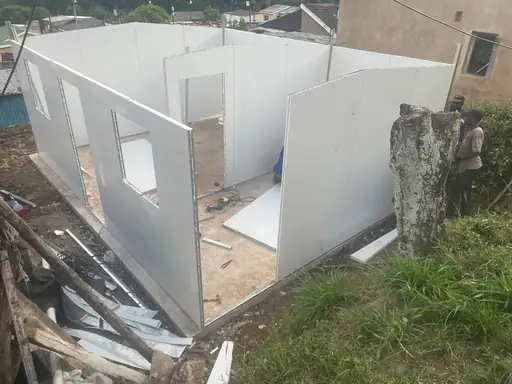
The steel frame goes up on site
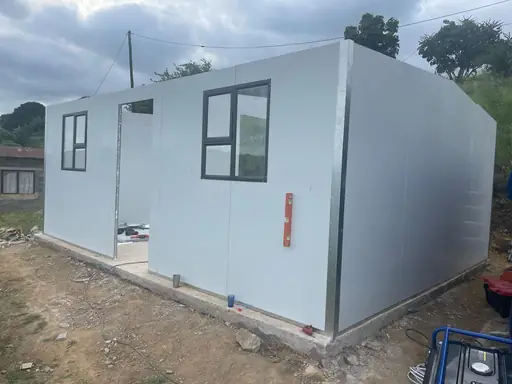
Shell closed, windows and door in
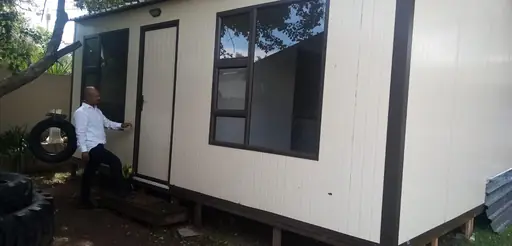
Finished and ready to hand over
What does it look like inside?
Four details, photographed in our own units, show what a spec sheet can't: how the corners meet, whether the power is real, what the floor is, and whether the bathroom works.
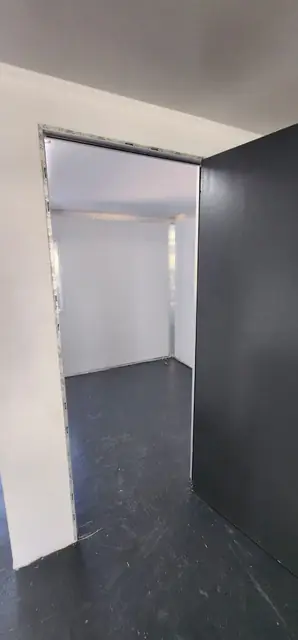
Panel joints finished square, not caulked over
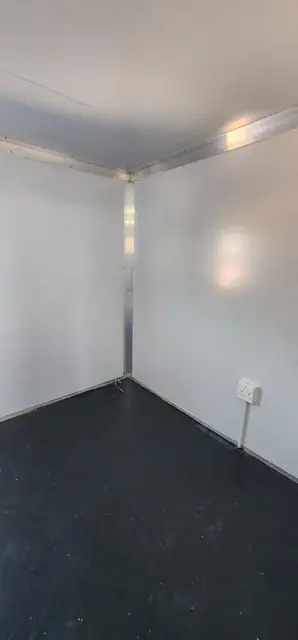
Wired for power, not just plumbed for later
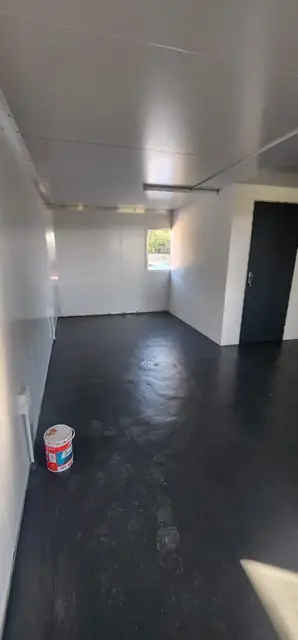
Screeded floor, ready for a family to finish as they choose
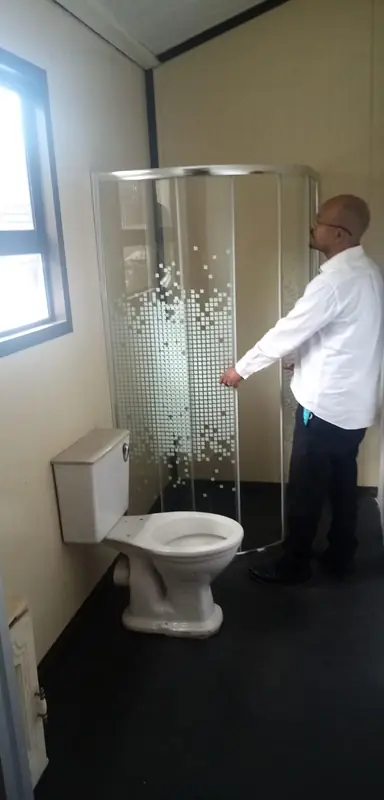
A bathroom that works — not a promise for later
The joints are finished square. Where two panels meet at a corner, the seam is finished cleanly rather than hidden under a bead of caulk.
A socket is wired in. The unit is wired for power, not left with a gap where electricity might go one day.
The floor is screeded. It is a finished base, ready for a family to finish as they choose.
The bathroom is fitted. A toilet and shower are installed inside the unit: a bathroom that works, not a promise for later.
How is it different from the shack it replaces?
The fair comparison is not a suburban house. It is what a family has today, and what conventional brick construction would cost to give them instead. This is the comparison our partner page publishes.
| Shack (today) | UDRS modular unit | Conventional brick build | |
|---|---|---|---|
| Time to occupancy | Days | Days once delivered | Months |
| Cost per household | Near zero to build, repeatedly rebuilt | R150 000 | Materially higher |
| Fire behaviour | Spreads shack to shack | Engineered, non-improvised structure | Resistant |
| Relocatable | Only by demolition | Yes, by design | No |
| Weather & flooding | Leaks, floods, overheats | Sealed, raised, insulated | Good |
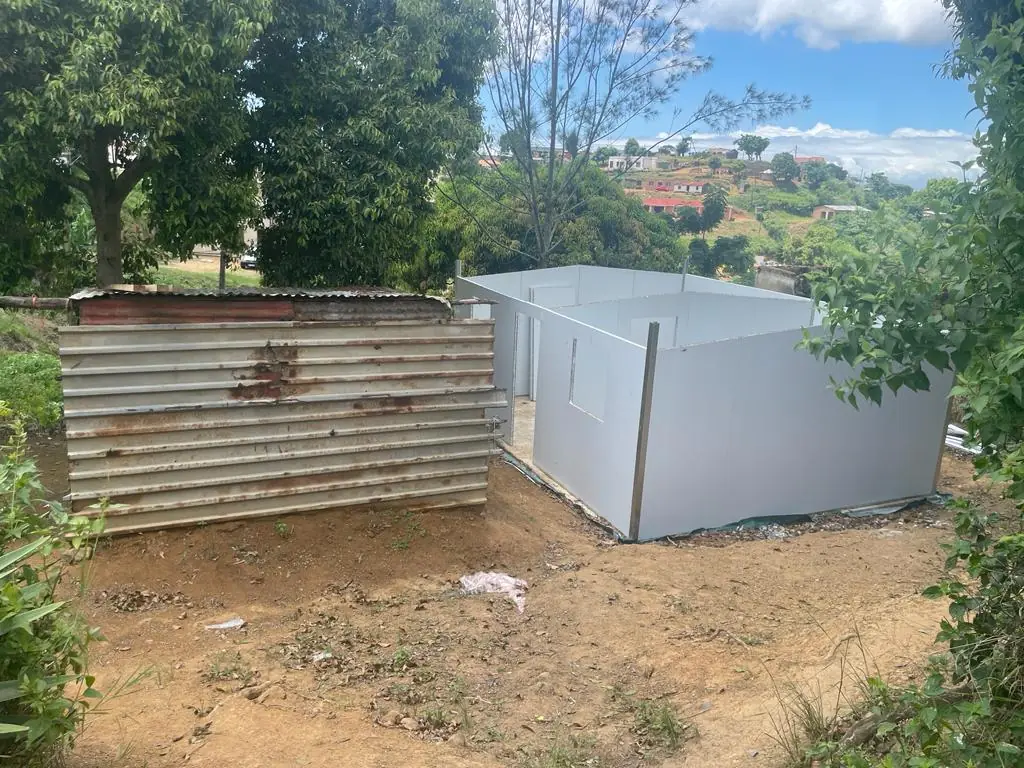
A UDRS modular unit beside the corrugated-iron shack it replaces
How big is it, and what does it cost?
Each unit costs R150 000 and is assembled on site in 7 days. Counting libraries and classrooms as well as homes, UDRS has built 41 units and amenities to date. Floor area for the production unit is the one figure still marked TBC while it's finalised.
| Figure | Status |
|---|---|
| Floor area | TBC m² |
| Assembly on site | 7 days |
| Cost per unit | R150 000 |
| Units & amenities built | 41 |
A plausible invented number would read better today and be a liability for as long as this page exists. If you need the current pilot figures for a funding decision, ask us directly and we'll give you what we have.
What the photographs do show is more than one configuration. Our gallery includes a double-storey unit built at the UDRS workshop, with an external steel staircase, and a unit fitted with a roof-mounted solar panel.
Why is it still called a pilot?
Because a working unit is not yet a repeatable programme. The pilot proved the unit can be built, placed and lived in. Proving it can be produced at a fixed price, block by block, is the next piece of work, and we say so plainly.
- Pilot units in Kya Sand — built, placed and lived in. This is where we are.
- Costing the repeatable version — turning what the pilots taught us into a fixed bill of materials and a per-unit price that holds at volume.
- Funding the first block — a contiguous group of units rather than scattered ones, so the services case can be made properly. This is the stage we are raising for now.
Can you see one in person?
Yes, and we'd prefer you did. You're welcome in Kya Sand to stand in a unit, and we strongly prefer a site visit before any commitment. If the trip doesn't fit your calendar yet, our partner page has a narrated video walkthrough of the site and a finished unit.
Companies can also sponsor a home: one named unit for one identified family, documented from delivery to handover. Contributions can be designated to a specific programme, unit or settlement, and reported against that designation. UDRS NPC is an approved Public Benefit Organisation, PBO 930091096; see how Section 18A giving works and how much a company can deduct under Section 18A.
Key points
- A UDRS modular home is manufactured off-site, delivered flat and assembled on site in days.
- It is relocatable by design, because tenure in a settlement is rarely permanent.
- Inside: square-finished joints, a wired socket, a screeded floor and a bathroom with toilet and shower.
- The units in Kya Sand are a pilot: built, placed and lived in. Each costs R150 000 and assembles in 7 days; floor area is still TBC.
- Every photograph here is our own unit, not a render or a supplier's catalogue.
Frequently asked questions
What is a modular home for an informal settlement?
In UDRS's case, a home manufactured off-site, delivered flat and assembled on site in days, designed to be relocatable because tenure in a settlement is rarely permanent. Our pilot units in Kya Sand are built, placed and lived in.
Are the photos of real UDRS units?
Yes. Every photograph in this post is our own unit or build, not a render or a supplier's catalogue. You're welcome in Kya Sand to stand in one.
How much does a UDRS modular home cost?
R150 000 per unit, as published on our partner page. Costing the repeatable version at volume is the next stage of the programme.
How many units have been built?
UDRS has built 41 units and amenities to date, counting libraries and classrooms as well as homes. The pilot units in Kya Sand are built, placed and lived in.
Does the unit have a bathroom and electricity?
Yes. The units we photograph have a bathroom fitted with a toilet and shower, and a wired electrical socket, alongside a screeded floor and square-finished panel joints.
Can the unit be moved?
Yes, by design. The unit can be lifted and moved, so a family isn't forced to choose between a home and a chance at land.
Can a company sponsor a specific unit?
Yes. Sponsor a home funds one named unit for one identified family, documented from delivery to handover. Contributions can be designated to a specific unit and reported against that designation.
See the full gallery and specification
Every unit photo, the comparison against brick, and the three stages of the housing programme are on our partner page. Or ask us for the current pilot figures directly.
Sources
Every fact in this post comes from our own published pages, re-checked against the live site on 3 October 2026:
- Partner & invest: The unit — how the unit is built, the interior detail photographs and captions, the unit specification, the pilot stages, the site-visit offer and the sponsor-a-home track
- Partner & invest: Against the alternatives — the comparison table