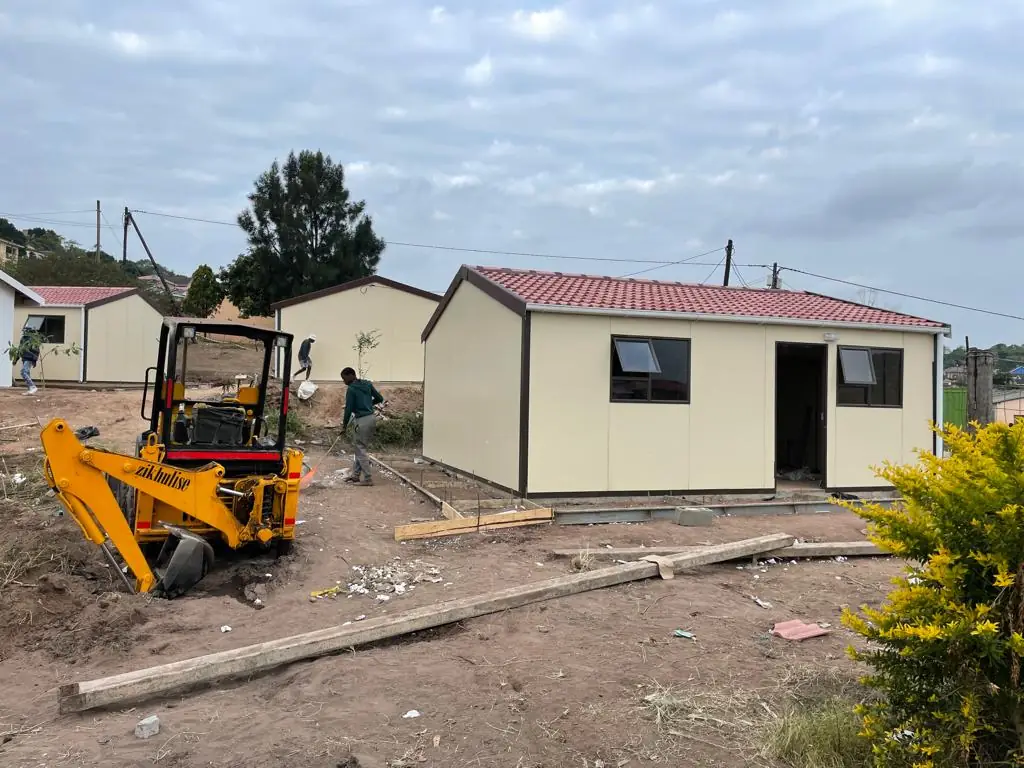
UDRS builds its modular homes to be relocatable because tenure in a settlement is rarely permanent, and a home that can't move becomes a home that gets abandoned. The unit is manufactured off-site, delivered flat and assembled on site in days, and can be lifted and moved, so a family isn't forced to choose between a home and a chance at land.
At a glance — as of October 2026
- The design reason
- Tenure in a settlement is rarely permanent
- How it's made
- Manufactured off-site, delivered flat, assembled on site in days
- Can it move?
- Yes, by design — the unit can be lifted and moved
- Status
- Pilot: units in Kya Sand, built, placed and lived in
- Assembly on site
- 7 days
- Cost per unit
- R150 000
- Units & amenities built
- 41, counting libraries and classrooms as well as homes
- Next step
- Costing the repeatable version
Why would you build a home that can be moved?
Because the land is often the least certain part of a family's situation. Tenure in a settlement is rarely permanent, and a home that can't move becomes a home that gets abandoned the moment the land does.
A conventional house assumes the plot will stay. When that assumption fails, everything built into the ground is lost. A relocatable unit lets the family keep the home even when the address changes.
What does relocatable actually mean for this unit?
It means the home is built from manufactured panels and a steel frame that go up on site, rather than formed in place. The unit can be lifted and moved, so a family isn't forced to choose between a home and a chance at land.
The contrast on our partner page is plain: a shack can be relocated only by demolition, a conventional brick build not at all, and the UDRS unit yes, by design.
| Shack (today) | UDRS modular unit | Conventional brick build | |
|---|---|---|---|
| Relocatable | Only by demolition | Yes, by design | No |
| Time to occupancy | Days | Days once delivered | Months |
| Fire behaviour | Spreads shack to shack | Engineered, non-improvised structure | Resistant |
How does it get from workshop to plot?
In steps visible in our own photographs: panels leave the workshop flat, the frame goes up on site, and the shell is closed with windows and a door. Quality is controlled in a workshop, not improvised in a yard, and site time drops to days.
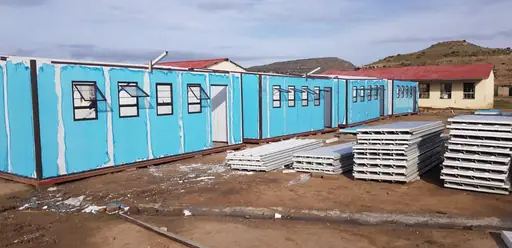
Panels leave the workshop flat
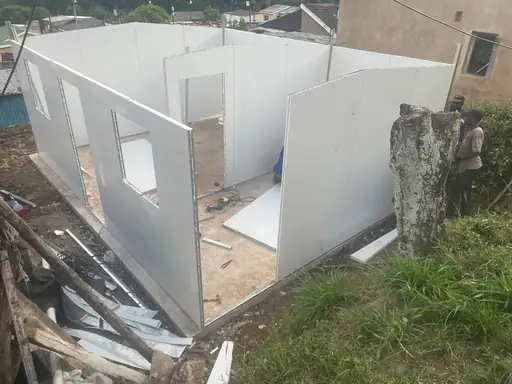
The steel frame goes up on site
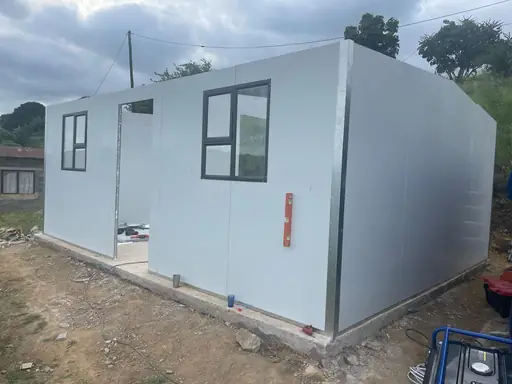
Shell closed, windows and door in
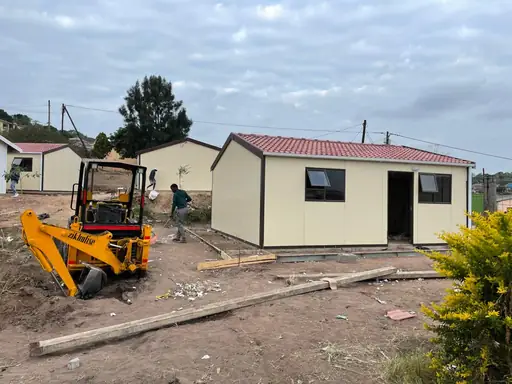
Assembly on site, in days, not months
What does "assembled in days" mean for a family in a shack?
It means the gap between an unsafe structure and a sealed one is measured in days once the unit is delivered, not months. The comparison that matters is the shack the family lives in today: it leaks, floods and overheats, and fire spreads from one to the next.
The figure is 7 days of assembly on site, as published on our partner page.
Assembly takes 7 days on site and each unit costs R150 000. Floor area for the production unit is still being finalised. If you need the current numbers for a funding decision, ask us directly.
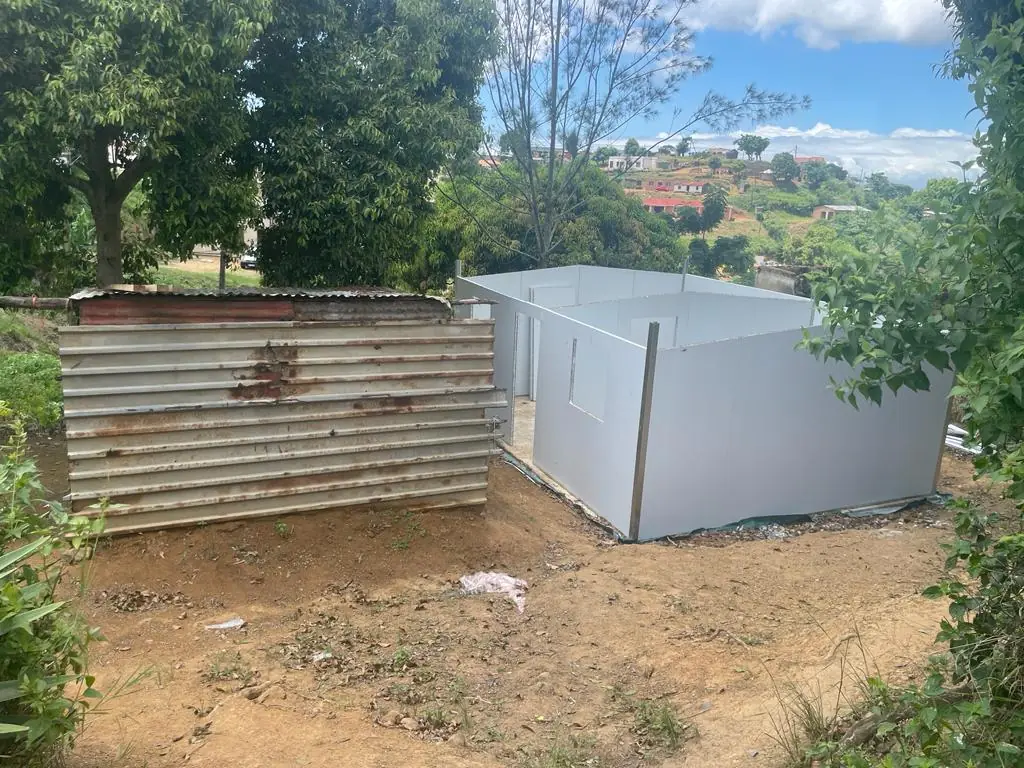
A UDRS modular unit beside the corrugated-iron shack it replaces
Does relocatable mean temporary?
No. Relocatable describes how it is built, not how long it lasts. The unit is a home a family lives in now; the design simply doesn't punish them if the land changes. The pilot units in Kya Sand are built, placed and lived in.
It is also still a pilot, not a scaled programme. Proving the unit can be made at a fixed price, block by block, is the next stage.
- Pilot units in Kya Sand — built, placed and lived in. This is where we are.
- Costing the repeatable version — a fixed bill of materials and a per-unit price that holds at volume.
- Funding the first block — a contiguous group of units, so the services case can be made properly.
Can you see one in person?
Yes, and we'd prefer you did. You're welcome in Kya Sand to stand in a unit, and we'd rather you saw it before any money moves. For the full inside view, read what the Kya Sand pilot units actually look like.
Companies can also sponsor a home: one named unit for one identified family. UDRS NPC is an approved Public Benefit Organisation, PBO 930091096. See how Section 18A giving works.
Key points
- Tenure in a settlement is rarely permanent, and a home that can't move gets abandoned.
- The UDRS unit is manufactured off-site, delivered flat and assembled on site in days.
- It can be lifted and moved: a shack only by demolition, brick not at all.
- Relocatable is about how it is built, not how long it lasts.
- It is a pilot. Each unit assembles in 7 days on site and costs R150 000.
Frequently asked questions
Why are UDRS modular homes relocatable?
Because tenure in a settlement is rarely permanent, and a home that can't move becomes a home that gets abandoned. The unit can be lifted and moved, so a family isn't forced to choose between a home and a chance at land.
What does relocatable mean for a modular home?
It means the home is built from manufactured panels and a frame that go up on site, rather than formed in place, so it can be lifted and moved instead of demolished. Our partner page describes the UDRS unit as relocatable by design.
How long does it take to assemble a UDRS unit?
7 days on site. The unit is manufactured off-site and delivered flat, so the on-site work is assembly, not construction.
Is a relocatable home as safe as a brick house?
We make no claim that it is equivalent to brick. The comparison we publish is against the shack a family lives in today: an engineered, non-improvised structure that is sealed, raised and insulated. Brick is resistant but takes months and costs materially more.
How many relocatable units has UDRS placed?
UDRS has built 41 units and amenities to date, counting libraries and classrooms as well as homes. The pilot units in Kya Sand are built, placed and lived in.
What does a relocatable UDRS home cost?
R150 000 per unit, as published on our partner page. Costing the repeatable version at volume is the next stage of the programme.
See the housing pilot
The unit, the stages of the programme and the comparison against brick are on our partner page. Or ask us for the current pilot figures directly.
Sources
Every fact in this post comes from our own published pages, re-checked against the live site on 12 October 2026:
- Partner & invest: The unit — off-site manufacture, relocatable design reasoning, the unit specification and the pilot stages
- Partner & invest: Against the alternatives — the comparison table