
UDRS NPC runs four programmes: emergency relief for families hit by fires and other disasters; education support that keeps children in school with uniforms, stationery and workshops; health and hygiene drives built around sanitary products; and housing innovation, including a modular-housing pilot in Kya Sand that is built, placed and lived in, but not yet scaled.
At a glance — as of October 2026
- Who
- United Dream Rivers Services NPC, Reg 2023/888882/08, an approved Public Benefit Organisation
- Relief
- Food parcels, warm clothing, blankets and household items after fires and emergencies
- Education
- School uniforms and shoes, stationery and books, sanitary products, workshops and mentorship
- Health & hygiene
- Sanitary product drives, hygiene education, health awareness and community health days
- Housing
- Advocacy, plus a modular-housing pilot: units in Kya Sand built, placed and lived in
- Where
- 1412 Agnes Ave, Bloubosrand, Randburg
What are the four UDRS programmes?
They are Community Relief & Emergency Support, Education & Youth Empowerment, Health & Hygiene, and Housing Innovation & Community Support. Our What we do page sums them up in one line: relief when disaster strikes, a path back to school, dignity and hygiene, and a fight for safe, permanent housing.
The thread between them is that every programme is built with the community, not for it. We listen first, plan with community members, deliver with dignity, and measure what changed.
| Programme | What it does | Published figures |
|---|---|---|
| Community Relief & Emergency Support | Food parcels, warm clothing, blankets, household items, temporary shelter coordination | 30+ families assisted after fires; 500+ food parcels; 24h average response time |
| Education & Youth Empowerment | Uniforms and shoes, stationery and books, sanitary products, mentorship, motivational workshops | 200+ children supported; 50+ school uniforms; 12 workshops |
| Health & Hygiene | Sanitary product distribution, hygiene education, health awareness campaigns, community health days | 100 hygiene packs; 6 fire safety workshops; monthly product drives |
| Housing Innovation & Community Support | Modular-housing pilot, community voice and stakeholder connections, housing rights education, government liaison | 5 community meetings; 3 stakeholder engagements; ongoing advocacy |
What does Community Relief & Emergency Support cover?
It is the first response after a fire or emergency. When a family loses its home, we distribute food parcels, warm clothing, blankets and essential household items so they can get back on their feet, and we help coordinate temporary shelter.
Our services page lists a 24-hour average response time, more than 30 families assisted after fires and more than 500 food parcels distributed. Our Nkgotwe fire response page shows one of those responses in photographs.
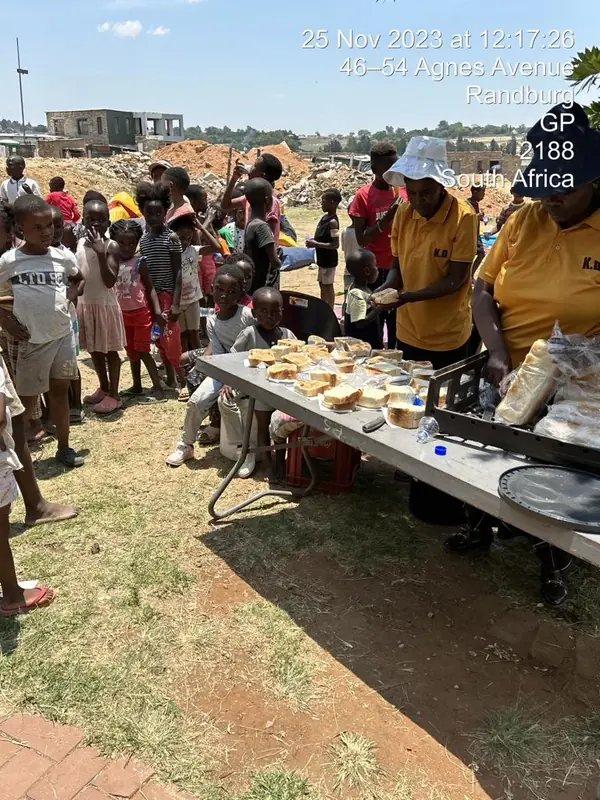
Food served from a folding table, not a stage
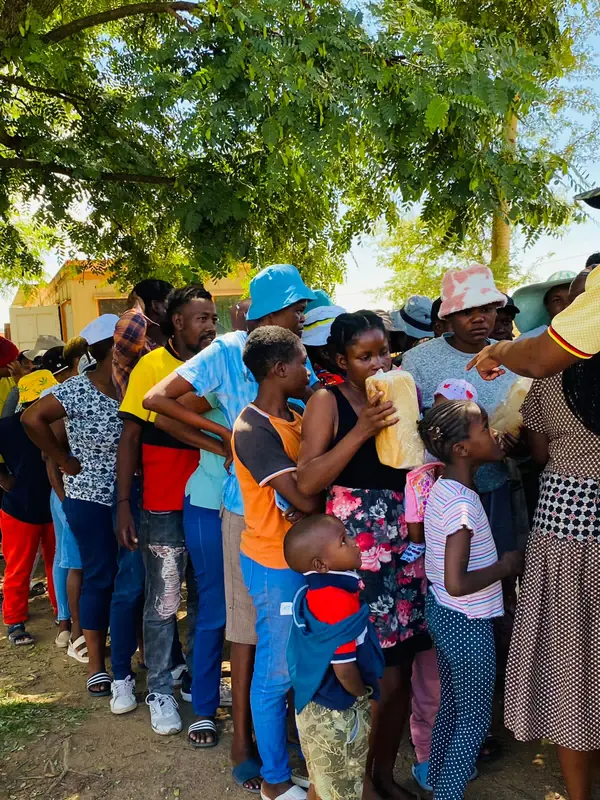
Families queuing at a distribution day
What does Education & Youth Empowerment cover?
It removes the practical reasons a child misses school. We provide school uniforms and shoes, stationery and books, and sanitary products, so a missing item isn't what keeps a child at home. We also run mentorship and host motivational workshops for young people.
Our services page lists more than 200 children supported, more than 50 school uniforms provided and 12 workshops held. On our donate page, R500 is costed as a school uniform, stationery and books for a year.
What does Health & Hygiene cover?
It treats hygiene as a matter of dignity, not a luxury. Through sanitary product drives and community awareness work, the programme makes sure no one has to compromise their health or self-respect for lack of basic products.
In practice that means sanitary product distribution, hygiene education, health awareness campaigns and community health days. Our services page lists 100 hygiene packs distributed, six fire safety workshops and product drives run monthly.

Packs handed out across a table, one queue at a time
What does Housing Innovation actually involve?
Two things: advocacy, and a modular-housing pilot. We work alongside residents of informal settlements to move from unsafe shacks toward safe, dignified shelter, through community meetings, stakeholder connections, housing rights education and liaison with government.
Alongside that, we are piloting portable, modular housing units, manufactured off-site and quick to assemble on site. The pilot units in Kya Sand are built, placed and lived in. Our services page lists five community meetings and three stakeholder engagements held so far.
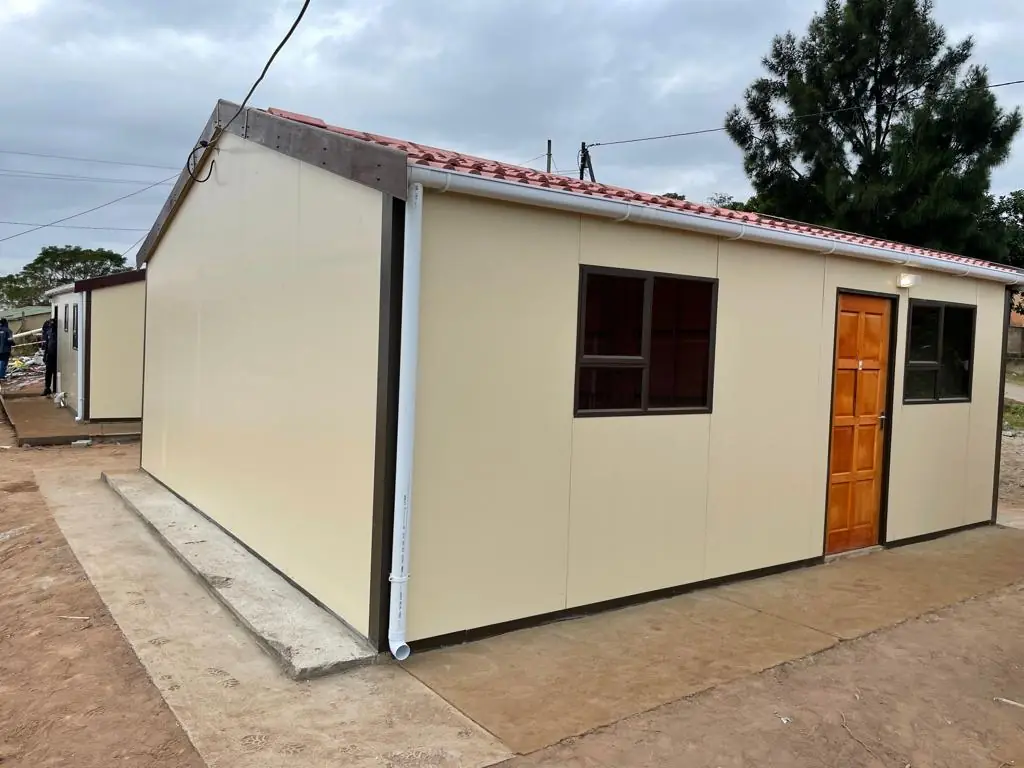
A completed pilot unit — our own, not a supplier's catalogue
Is the housing programme already running at scale?
No, and we say so plainly. It is a pilot. The units work and families live in them; what isn't finished yet is turning the pilot into a repeatable programme with a fixed bill of materials and a per-unit price that holds at volume.
- Pilot units in Kya Sand — built, placed and lived in. This is where we are.
- Costing the repeatable version — the next step: turning what the pilots taught us into a fixed price.
- Funding the first block — a contiguous group of units rather than scattered ones, the stage we are raising for now.
Each unit costs R150 000 and assembles on site in 7 days, and UDRS has built 41 units and amenities to date, counting libraries and classrooms. For the full walkthrough, read what the Kya Sand pilot units actually look like.
How can you support a specific programme?
Individuals can give from R150, a fire blanket and two hot meals, once or monthly. Volunteers can give a Saturday instead of a salary. Our every way to help page compares all the options side by side.
Companies can designate a contribution to a specific programme, unit or settlement and receive reporting against that designation. UDRS is an approved Public Benefit Organisation, PBO 930091096; see how Section 18A giving works and the partner case.
Key points
- UDRS runs four programmes: relief, education, health and hygiene, and housing innovation.
- Relief means food parcels, clothing, blankets and household items after fires and emergencies.
- Education removes practical barriers: uniforms, stationery, sanitary products, workshops and mentorship.
- Health & hygiene runs sanitary product drives, hygiene education and community health days.
- Housing is advocacy plus a modular pilot in Kya Sand: built, placed and lived in, not yet scaled or priced.
Frequently asked questions
What does UDRS do?
UDRS NPC runs four programmes: community relief and emergency support after fires and disasters, education and youth empowerment, health and hygiene, and housing innovation, which includes a modular-housing pilot in Kya Sand.
What does UDRS stand for?
United Dream Rivers Services. UDRS NPC is a registered South African non-profit company (Reg 2023/888882/08) and an approved Public Benefit Organisation (PBO 930091096), based in Bloubosrand, Randburg.
What does UDRS give families after a fire?
Food parcels, warm clothing, blankets and essential household items, and help coordinating temporary shelter. Our services page lists a 24-hour average response time.
Is the UDRS housing programme a finished product?
No. It is a pilot: units in Kya Sand that are built, placed and lived in, at R150 000 per unit. The next step is costing the repeatable version at volume.
Can I choose which programme my donation supports?
Companies can designate a contribution to a specific programme, unit or settlement and receive reporting against that designation. Individual donors can ask us directly where a gift will go.
How can I help without giving money?
Volunteer. Our volunteer page lists roles from community days with children to tutoring and mentoring, skills from home, and trades and build work.
See every programme in full
Our services page has each programme's full list of activities, its published figures and its photographs. If you want to know where a specific gift would go, ask us directly.
Sources
Every fact in this post comes from our own published pages, re-checked against the live site on 7 October 2026:
- What we do — the four programmes, their activities, the how-we-work steps and every programme figure in this post
- Partner & invest — the housing pilot's three stages, the unit specification and designated giving
- Donate — what R150 and R500 buy