GIVE 10% OF YOUR TAXABLE INCOME. CUT YOUR TAX BILL BY 10%.
Section 18A of the Income Tax Act lets a South African taxpayer deduct bona fide donations to an approved Public Benefit Organisation, up to 10% of taxable income. UDRS is approved. Give the full ceiling and your tax bill falls by exactly 10% — money that was going to SARS either way, now putting a family under a real roof, with the certificate to prove it.
WHAT SECTION 18A ACTUALLY IS
A donation isn't competing with your tax bill. It redirects part of it.
Everything below is drawn to the same scale. Watch the tax bill first — that's the line you control.
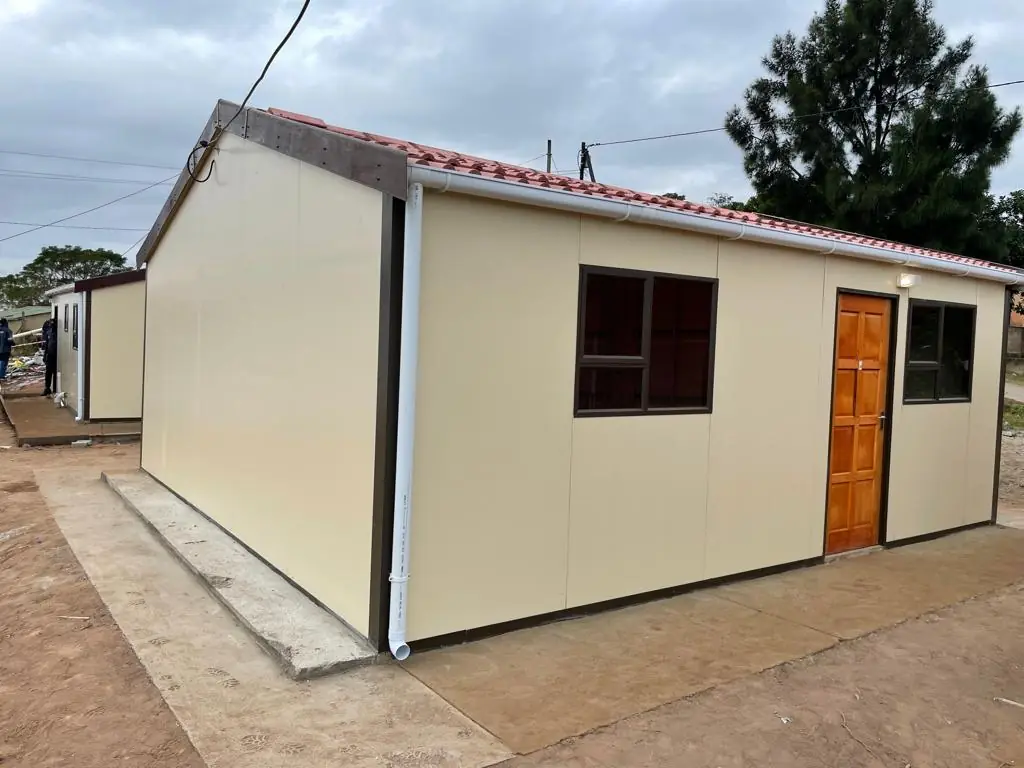
of housing on the ground for every R1 that actually leaves your business — because R27 000 of that R100 000 was tax you were paying anyway. At the 27% company rate.
Be straight about it: this is not a way to make money. You end the year R73 000 lighter. What you get for it is a tax bill you chose the destination of, R100 000 of work with your name on it, and the paperwork to prove both.
Donate to an approved PBO
Cash or goods. It must be given freely, with nothing coming back to you in return.
We issue the 18A certificate
A numbered receipt in the form SARS prescribes, carrying our PBO number and what you gave.
Claim it on your return
Deducted from taxable income for that year — up to 10% of it.
Your tax bill drops
Every R100 given cuts tax by R27. Anything over the ceiling carries to next year.
AN NPC WITH AN 18A LICENCE
A registered South African NPC and an approved Public Benefit Organisation. Our primary objective is shack eradication — replacing corrugated iron with portable, modular homes — alongside the programmes that keep families standing meanwhile: soup kitchens, school support, fire response. All of them are approved public benefit activities, which is why the deduction is available on money given to us.

THE 10% RULE
Section 18A lets you deduct donations of up to 10% of your taxable income in a year. Give the full 10% and your tax bill drops by exactly 10% — whatever rate you pay.
A COMPANY EARNING R100 MILLION
The tax bill fell by R2 700 000 — exactly 10% of it. That R2.7 million was never staying in the business either way; the only decision was its address. The remaining R7.3 million is the real cost of putting R10 million on the ground.
That the ceiling is 10% of the tax bill — so a company paying R27 million could give R2.7 million and no more.
The ceiling is 10% of taxable income. It is nearly four times bigger than most people expect, and the 10% that lands on the tax bill is the saving, not the limit.
WHAT IT ACTUALLY COSTS YOU
Start with your taxable income — that's what the 10% ceiling is calculated on. The gold portion of the bar is tax you were paying anyway.
Your numbers
What happens on your return
An illustration, not tax advice. It applies a single flat rate to the whole donation and ignores everything else on your return. UDRS is not a registered tax practitioner — confirm your own position with your accountant or tax advisor before you rely on a number. Rates shown are the South African company rate of 27% and the individual marginal brackets; deductions are limited to 10% of taxable income under section 18A, with any excess carried forward to the following year of assessment.
YOUR MONEY PAYS PROFESSIONALS
A shack replacement is an engineering problem. A child's marks are a teaching problem. Neither improves on good intentions alone — so the technical work goes to people qualified to do it, and that is where a Section 18A donation lands.
Engineers & draughtspeople
The unit is drawn, specified and signed off before one is built — and costed so the hundredth is cheaper than the first.
Qualified tutors
Maths, science and English after school — taught by people trained to teach, not homework supervision by whoever is free.
Artisans & trades
Assembly crews, plumbers and electricians — recruited from the settlement the unit is going into wherever the work allows it.
Community & social workers
Finding the households that need help most — child-headed families, the elderly, the disabled — and following up afterwards.
Logistics & drivers
Units, materials and relief loads have to physically arrive. Transport is the least glamorous line item and one of the biggest.
Kitchen & nutrition team
The soup kitchens run on people who cook safely and at volume, week after week, where a hot meal isn't otherwise guaranteed.
THE ENGINEERS BEHIND THE HOUSING PROGRAMME
MATO Engineers — civil and structural engineers, project managers and construction managers — design, sign off and manage delivery of every modular housing unit before it reaches a family.

Arnold M. Banda
Managing Director
Pr Eng, BSc Civil Engineering, MSAICE, MSAIPTACO
Senior civil and structural engineer with 27 years of experience in engineering project design and implementation across civil and structural works, water and sanitation, and highway engineering.
Capability areas Design coordination, structural analysis, municipal infrastructure planning, contract administration and implementation oversight.

Lehana Khalema
Business Development Director
PrCPM, ND Real Estate, BSc Building Science, MSc Project Management
Project management and PMO professional with 20 years of technical and managerial oversight experience across South Africa and SADC, including power, energy, hospitality, retail and residential sectors.
Capability areas Stakeholder engagement, project controls, PMO administration, team leadership and multidisciplinary delivery management.

Yemane Gebrekidan
Head of Contracts Management
BSc Civil Engineering, FIDIC, JBCC, NEC and GCC contracts training
Civil engineer and contracts specialist with 21 years of construction industry experience, covering FIDIC Red Book, FIDIC Yellow Book, JBCC, World Bank and Lesotho Government projects.
Capability areas FIDIC, NEC, JBCC and GCC contracts, claims and dispute management, risk, subcontract administration, planning and progress reporting.
Boyce Sonti
Design Office Manager
ND Civil Engineering, B-Tech Water (pending); civil design and modelling packages
Senior technician with 22 years of experience in planning, design, estimates and contract administration for water reticulation, sewer reticulation, stormwater management and road systems.
Capability areas Design draughting, Civil 3D, roads, bulk stormwater, foul sewer services, water reticulation, hydrology and hydraulic modelling.
How these people are engaged
Some are contracted per project, some work sessionally, and some donate professional time. Current headcount and the split between paid and pro-bono work for this financial year: TBC — ask us and we will send the figures rather than round them off on a web page. What we do not do is hand a technical job to enthusiasm.
SECTION 18A IS NOT B-BBEE
B-BBEE is a transformation scorecard. Section 18A is tax law. Neither depends on the other, and nothing here requires you to be chasing points.
| Section 18A donation | B-BBEE scorecard spend | |
|---|---|---|
| What it is | A deduction against taxable income | Points on a verification scorecard |
| Governed by | Income Tax Act, section 18A | B-BBEE Act and the Codes of Good Practice |
| What you receive | A numbered 18A certificate for your return | A rating from a verification agency |
| Who can use it | Any South African taxpayer with taxable income | Entities being measured for B-BBEE |
| Ceiling | 10% of taxable income, excess carried forward | Set by the applicable scorecard targets |
| Effect on cash | Reduces tax payable in that year of assessment | No direct effect on the tax bill |
Scroll the table sideways to compare →
If your scorecard matters too
Socio-economic development spend is assessed by your verification agency, against its own criteria — not by us and not by SARS. Where a donation to UDRS also qualifies there, we will give your verifier whatever documentation they ask for. We just won't sell you points we aren't the ones awarding.
SECTION 18A IN PLAIN LANGUAGE
If you would rather hear it than read it, this walkthrough covers the same ground: what qualifies, what the certificate has to contain, and how the deduction is claimed. Our own version, recorded on site in Kya Sand, is coming — this one holds the fort in the meantime.
Third-party explainer, hosted on YouTube. Not produced by UDRS.
WHAT WE NEED TO ISSUE THE CERTIFICATE
An 18A receipt is a prescribed document, and SARS requires us to report what we receipt in third-party IT3(d) returns. So we need real details — not on the form below, but once you've decided to give.
We collect those directly, once you have committed — never through a public web form. Nothing on this page asks for a tax number.
GIVE BEFORE YOUR YEAR END
The deduction lands in the year the donation was paid. Give the day after your year end and it waits twelve months to do anything for your tax bill — so if you're working to a date, say so on the form.
Once-off donations
Certificate issued against that payment, normally within a few working days of the funds reflecting.
Monthly or recurring giving
One consolidated certificate covering the tax year, so your accountant handles one document instead of twelve.
Donations in kind
Materials, vehicles, food, equipment — goods qualify too. Value has to be established properly, so talk to us before delivery.
Over the 10% ceiling
Nothing is lost. The excess is carried forward and treated as a donation in the following year of assessment.
SHARE YOUR SECTION 18A BENEFIT WITH US
You are giving that money away either way — 27% of your profit has a destination already. This is the version where you choose it, see it, and can drive out to Kya Sand and stand in what it built.
You send this form
Rough shape only. No commitment, no amount required, no documents.
We reply within two working days
With what your figure would actually buy, how the certificate works for your structure, and honest answers on what we cannot do.
You come and look
A site visit before any money moves. We would rather you saw it than took our word for it.
Certificate follows the donation
Issued against the payment, with reporting on where it went afterwards.
Section 18A enquiry
SECTION 18A QUESTIONS
The ones a finance team asks before signing anything off.
Are you actually approved for Section 18A?
How much can we actually deduct?
Is the 10% on our tax bill or on our income?
What counts as a bona fide donation?
Can we donate goods instead of cash?
When do we get the certificate?
Does this help our B-BBEE scorecard?
Do individuals get this too, or only companies?
Can we ring-fence what we fund?
Everything on this page is general information about Section 18A of the Income Tax Act, published to help you have a useful conversation with your own advisor. UDRS NPC is not a registered tax practitioner and this is not tax advice. Tax rates, limits and reporting requirements change — confirm the current position with your accountant or with SARS before you file.
THE 27% IS LEAVING EITHER WAY
The only question on the table is whether it disappears into general revenue or turns into a home with a door that locks. We are ready when your finance team is.